
Bike Phone Mounts Compared: Quad Lock, SP Connect and the Cheaper Ways
A phone only becomes a bike computer once it has somewhere solid to sit. Mounts are sold by the dozen, yet they differ far less than the brand names suggest: there are four fixing principles in practice. So before pitting Quad Lock against SP Connect, it is worth answering a question that has nothing to do with brands. Are you willing to have something stuck to your phone permanently?
Four ways to fix a phone to a handlebar
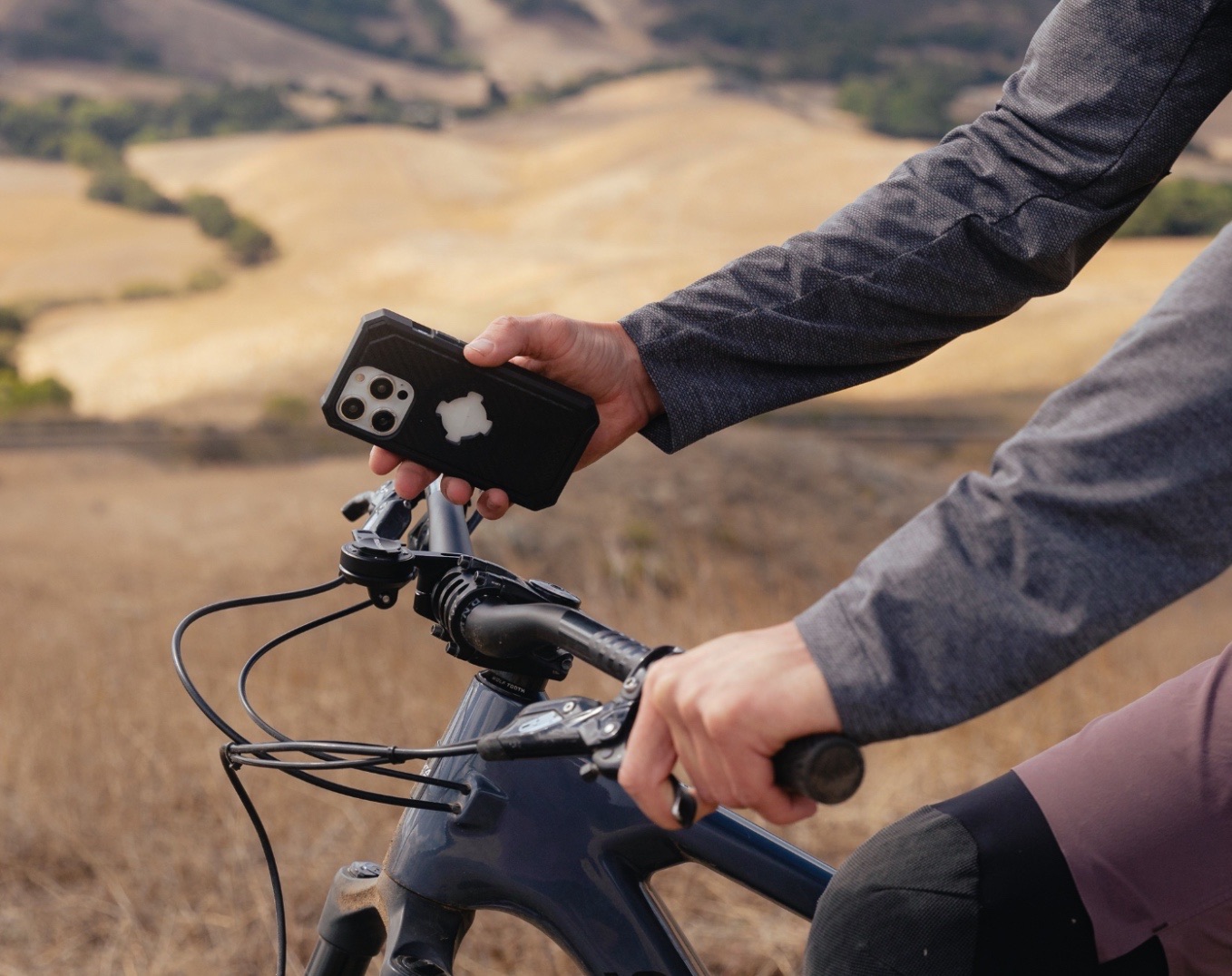
A case with the fitting built in. The locking part is moulded into a case made for one phone model. It sits lowest, and the phone goes on in a single movement. The bill arrives when you change phone, because the case has to be bought again.
An adapter you stick to your case. An adhesive plate gives the case you already own the same fitting. Every large maker sells one, so the branded case stops being necessary, which shop listings tend to keep quiet about.
A mount that grips the phone. Silicone straps or spring-loaded jaws hold the phone itself. Nothing is stuck to it and any model fits, but the whole thing stands further off the bar and taking the phone off needs both hands.
A sleeve with a window. The phone goes into a pouch you operate through clear plastic. Alone among the four it copes with heavy rain, but it covers the camera and stops the phone shedding heat.
Every mount below belongs to one of these four groups. Day-to-day convenience is decided by which group you pick, not by which brand you pick inside it.
The comparison at a glance
| System | How it holds the phone | What it needs on the phone | Rotation | Changing phone |
|---|---|---|---|---|
| Quad Lock | A twist, with a patented dual-stage lock | Their case, or a 5 mm adapter | Any angle, in steps | New case, or move the adapter |
| SP Connect | A twist; magnetic as well on the Mag models | Their case, or the adhesive Universal Interface | Portrait or landscape | New case, or move the adapter |
| Peak Design | SlimLink, meaning magnets plus a latch | Their case, or the Universal Adapter | 32 fixed positions | New case, or move the adapter |
| Rokform | A RokLock twist and MagSafe-compatible magnets | Their case, or a MagSafe case | In steps | New case |
| Zéfal Z Console | The phone sits in a cradle that turns an eighth into the base | Nothing | Portrait or landscape | Nothing to change |
| Bone Bike Tie | Silicone straps around the phone | Nothing | Free | Nothing to change |
| Universal clamps | Spring-loaded jaws | Nothing | Usually free | Nothing to change |
Prices are not in this table. They vary between shops and move from week to week, so a guide that lists them starts misleading readers within months. Amazon’s associate agreement forbids it in any case, unless the prices come from their own product interface.
Quad Lock
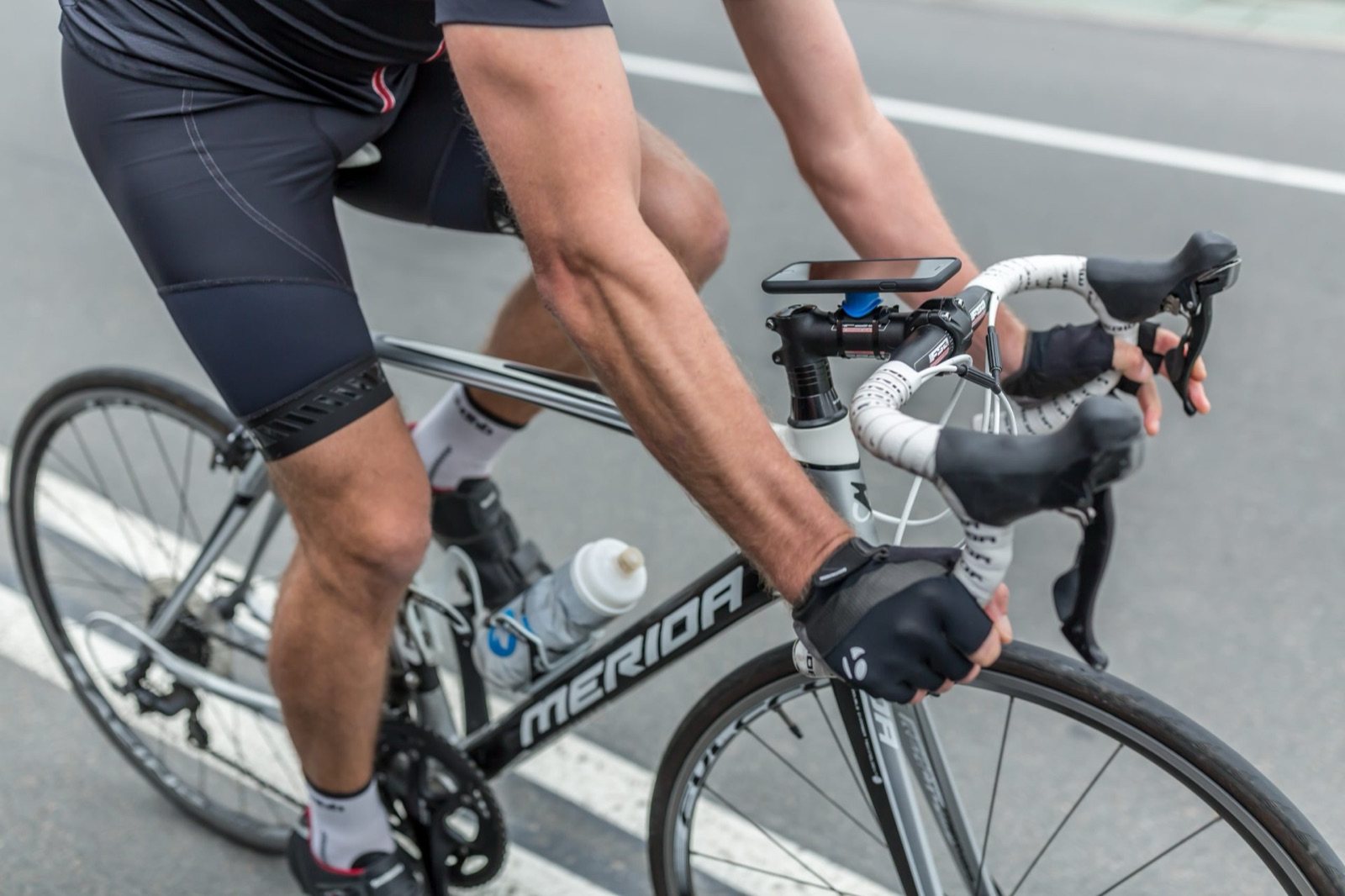
The brand most people start with, and not without reason. The phone goes onto the base with a twist of a few dozen degrees; the maker calls the mechanism a patented dual-stage lock, because the twist seats the phone while a separate spring-loaded catch keeps it there. The handlebar and stem base measures 23 millimetres tall and 35 wide, so it disappears among the rest of the cockpit.
Quad Lock’s real advantage, though, is the number of variants. The plain out-front mount can be reversed, and the phone then sits over the stem rather than ahead of the bar. The PRO version has a lower, stiffer arm in anodised aluminium. There is also a base that screws in between the stem and the top cap, the bolt closing the headset; it then takes up no bar space at all, and a double-sided head lets you move the lever to whichever side suits, which rescues the situation on a steeply angled stem.
You are not tied to their case. The universal adapter is five millimetres thick, 5.3 in the magnetic version, and holds on with 3M adhesive that bonds to most phones and cases. If you want to find out whether the system suits you at all, start there.
SP Connect
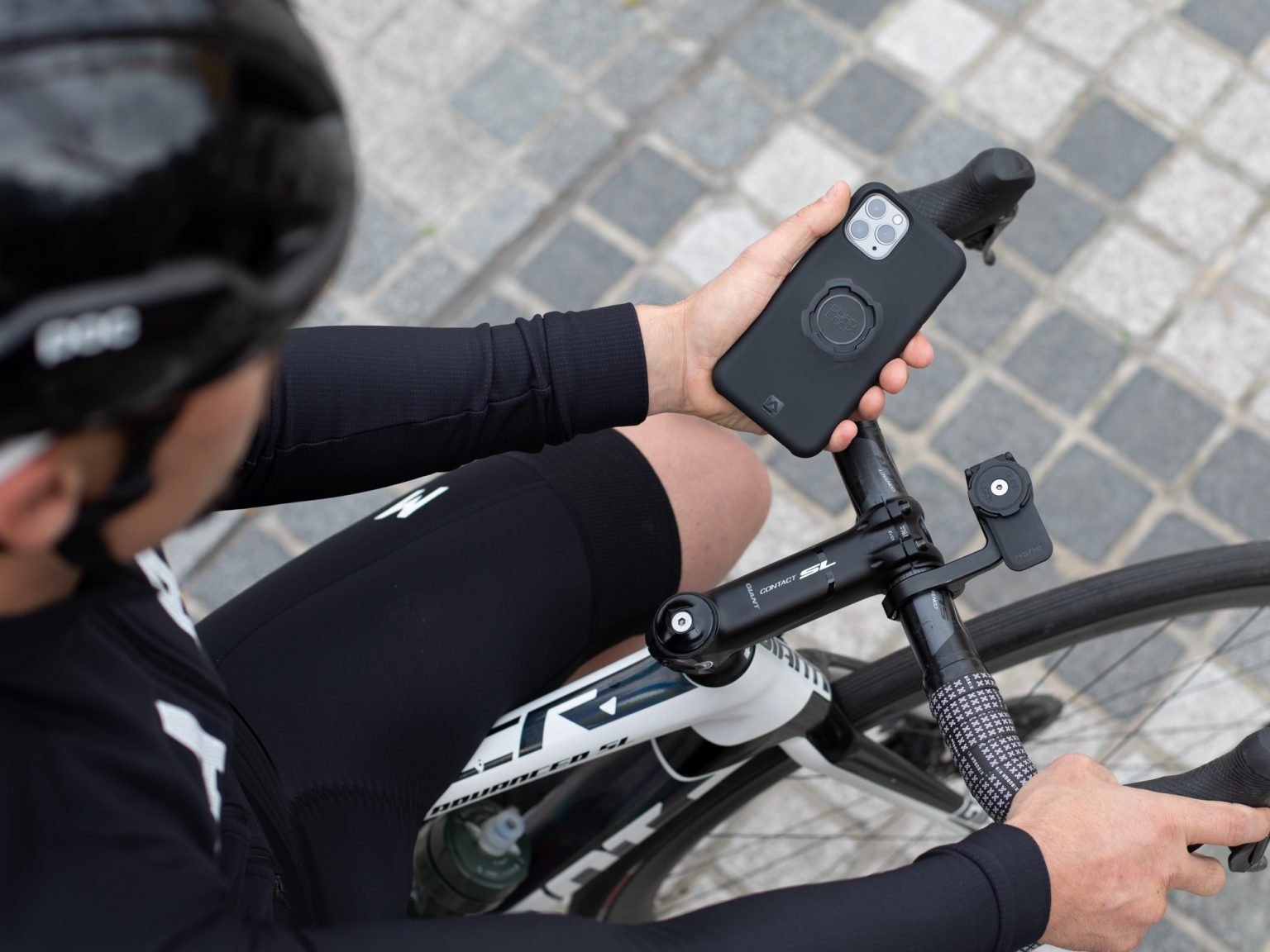
The mechanism works much the same way. The maker avoids quoting an angle and simply describes fitting the phone „with a turn of your wrist”. The difference lies elsewhere: SP Connect takes a broader view of what a base can be. Besides the usual handlebar and stem variants it offers adapters that seat the phone on a Garmin or Wahoo computer fitting, which counts if you already run an out-front bracket and have no intention of hanging a second one.
One thing needs saying plainly, because shop listings blur it. The Universal Bike Mount is universal with respect to the handlebar, not to the phone, since it still assumes you own an SP Connect case. What frees you from their cases is the Universal Interface: an adhesive plate that lets your existing case enter the same mechanism, mechanically or magnetically depending on the version. The same plate will happily hold a power bank.
SP Connect is also the only one of the three with an answer to rain. It sells a cover that pulls over the case and leaves the screen responsive to touch.
Peak Design
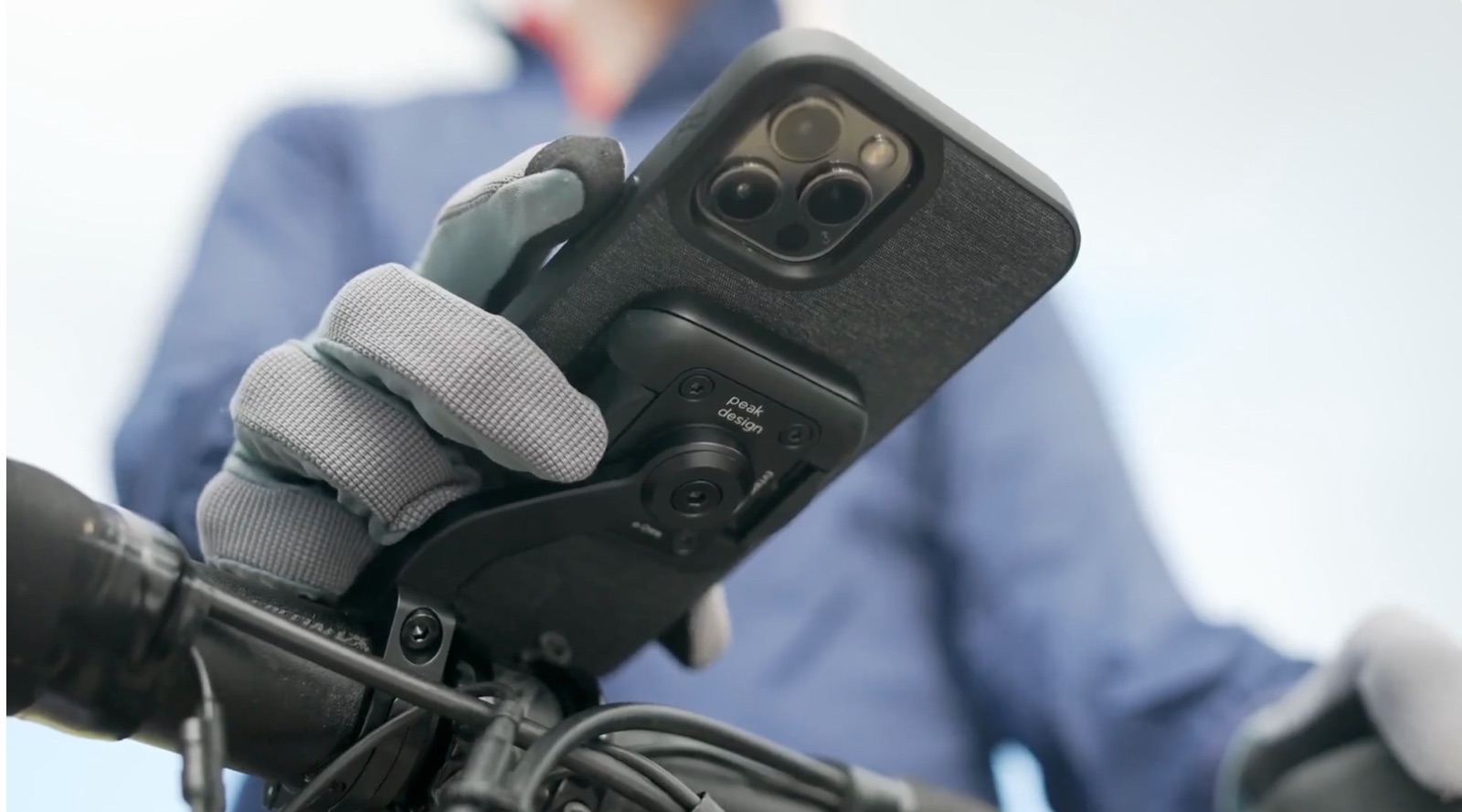
The latest to reach the market and the most pleasant in daily use. The SlimLink mechanism combines high-temperature neodymium magnets with a latch: the magnet draws the phone into place, the latch closes it there. The result is that the phone can be fitted one-handed, without looking at the mount, and comes off at the press of a button.
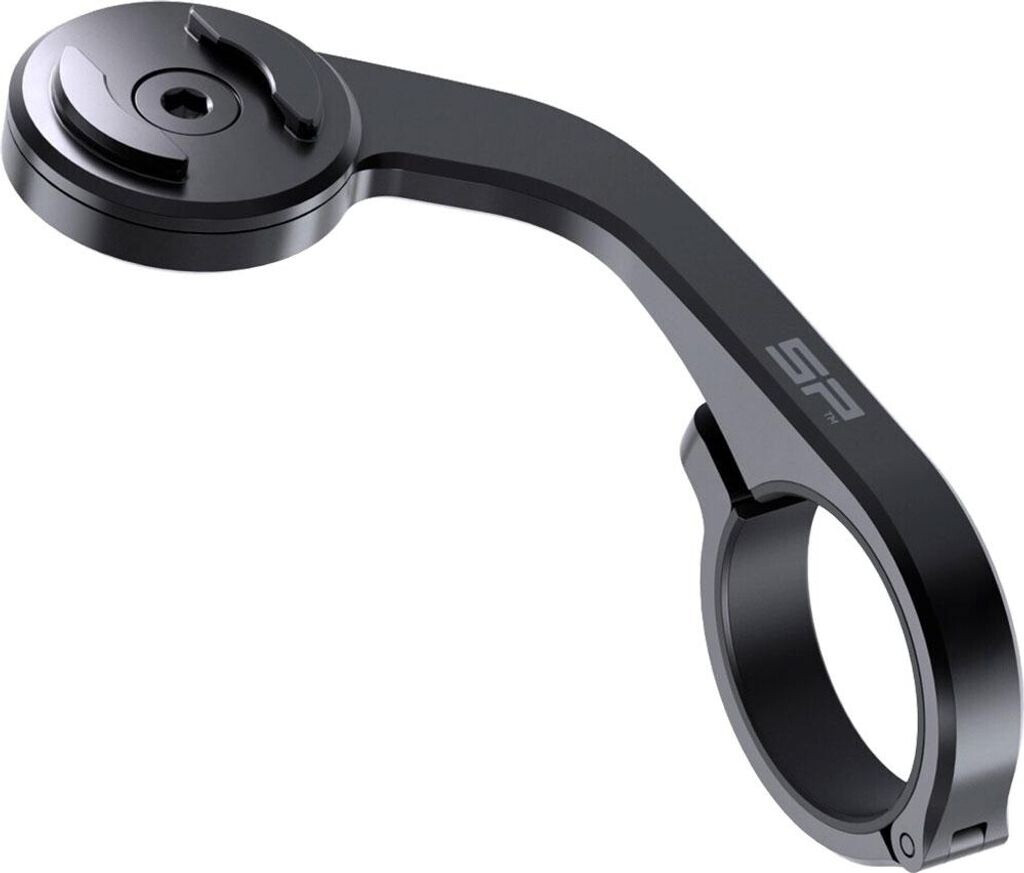
The out-front mount is made of machined, anodised aluminium with stainless steel fasteners. It weighs 87.1 grams with the hex screw and no collars, and the polycarbonate collars supplied cover bars from 22 to 35 millimetres. Underneath it carries a GoPro fitting, and an extra screw lets the head rotate for filming.
Worth knowing about separately is the Universal Bar Mount. It weighs 78 grams, holds on with a silicone band rather than screws, and its head clicks into 32 fixed positions, so the phone will sit level on a bar of any profile. Moving it to another bike takes a dozen seconds, which no bolted mount manages. Like the rest it needs either the maker’s case or their adapter.
The middle ground
Rokform sits between the top shelf and the cheap clamps. Machined 6061 T6 aluminium, a RokLock twist and MagSafe-compatible magnets, that is, the magnetic fitting found in newer phones. If you already own a MagSafe case, most of the job is done.
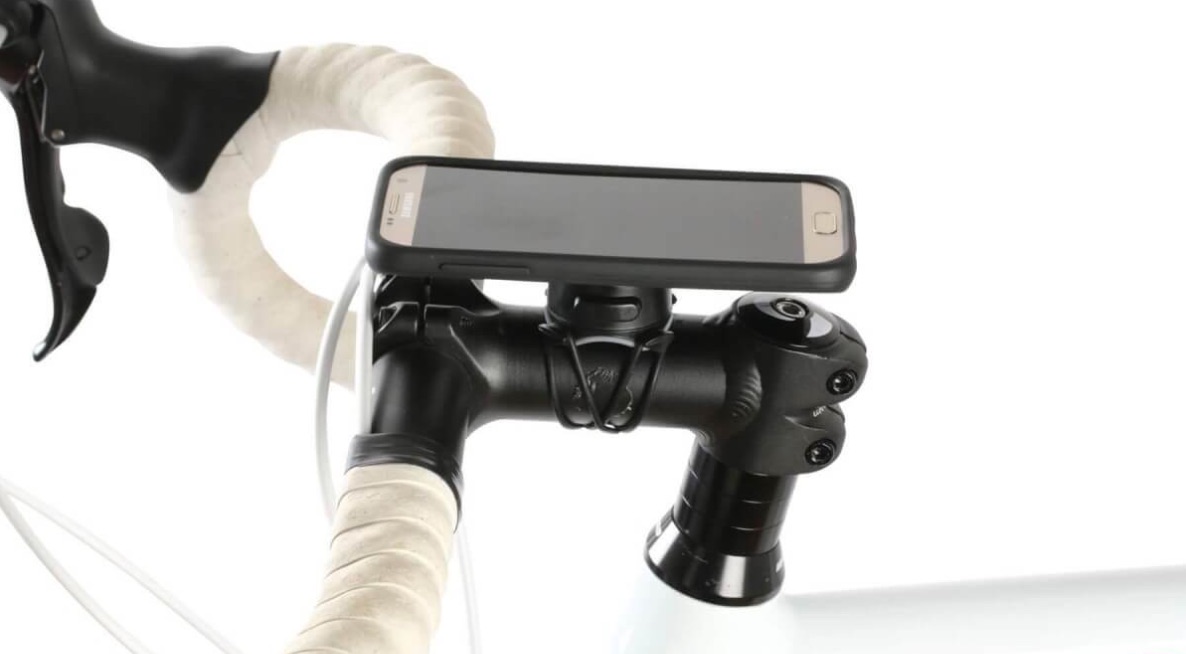
Zéfal’s Z Console goes in precisely the opposite direction. The phone slides into a cradle, so nothing is stuck to it, and anything up to 84 millimetres wide and 135 to 175 tall will fit. The cradle turns an eighth of a revolution into the base, sits portrait or landscape, and two buttons release it. Anyone riding whatever the weather should be looking at the sealed Dry version.
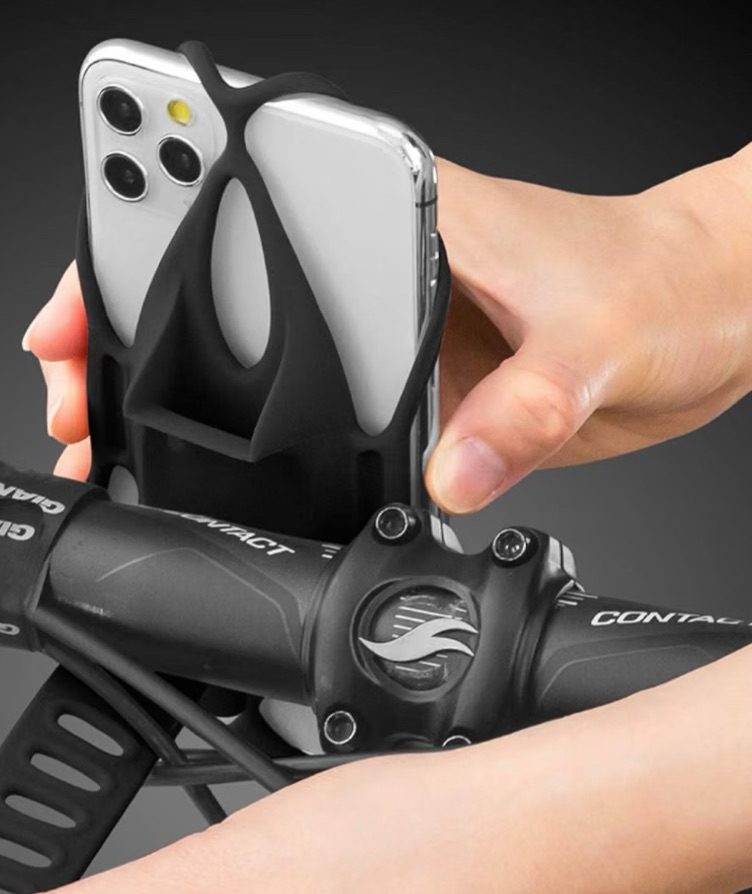
Bone’s Bike Tie Pro 4 is the simplest answer available: 65 grams of silicone straps that will take a phone from 4.7 to 7.2 inches and a bar from 22 to 45 millimetres. No tools, no adhesive, and the rubber itself damps vibration. You will not get it off one-handed, and that is the price paid here.
Universal clamps and what they cost you
The spring-jaw clamp outsells everything else and gets treated unfairly. It costs a fraction of a case system, fits every phone you will ever own, and on tarmac holds perfectly well. The drawbacks are real too. Fitting the phone takes two hands, the jaws like to press side buttons, and under a harder impact they can spring open, because nothing but spring tension holds them.
If that is the shelf your budget reaches, look for a model with a separate lock rather than jaw tension alone, and buy a tether as well. A tether earns its place on any mount, but here it decides whether the phone lands on the road or dangles under the bar.
Out-front mounting, and why screen position changes so much
An out-front mount carries the phone ahead of the bar, on an arm, where a computer normally sits. This is not about looks. The screen then falls in your natural line of sight rather than below it, so reading your speed costs a glance instead of dropping your head. The bar stays free for a light and a bell, and on the road bike the phone stops getting in the way of hands on the tops.
It costs two things. A longer arm acts as a lever and passes more vibration to the phone, and the mount itself becomes tied to one bike. All three of the larger makers offer one. If you ride with the phone in view for hours at a time, this is the position that makes it bearable.
Vibration and your phone’s camera
Guides here either say nothing or scare people, so let me cite the source. Apple has published a support note headed Exposure to vibrations, like those generated by high-powered motorcycle engines, might impact iPhone cameras. It says that high-amplitude vibration within certain frequency ranges can degrade optical image stabilisation and the autofocus system, and that attaching an iPhone to motorcycles with high-power, high-volume engines is not recommended.
It is worth reading what the note actually covers, though. Every example Apple gives has an engine: motorcycles, mopeds, scooters, drones. For small engines and electric drives the maker stops short of a warning and instead advises a vibration-dampening mount or a gimbal, and discourages prolonged daily use. Bicycles are not mentioned at all, and a bicycle has no engine producing the sustained narrow-band vibration the note is about.
The conclusion is therefore cautious in both directions. On a bicycle the risk is low, though not zero. Vibration from road surfaces and cobbles spreads across a wide band and comes in bursts; it is not the continuous resonance that damages stabilisation. Anyone riding rough surfaces daily loses little by following the dampening advice: a strap mount or a cradle isolates the phone better than a rigid aluminium arm. Anyone riding a motorcycle should take Apple literally.
What changes when the phone is the computer
A mount chosen for navigation is chosen differently from one you will stare at for four hours. With the screen on permanently the phone warms up and the battery vanishes, so the mount has to leave the charging port reachable. Check this before buying, because some out-front arms run exactly where the cable wants to go. For the same reason sleeves suit long rides poorly: they hold the heat in.
The other half of it is screen position. When the phone replaces the computer and you are following live cadence or speed, what you need is a glance, not a look. That argues for an out-front mount over a stem base, and for a system that comes off one-handed when you stop. Which gear you ought to be turning at that cadence is answered by the gear ratio calculator.
Questions and answers
Do I have to buy a special case? No. Quad Lock, SP Connect and Peak Design all sell adhesive adapters that give the fitting to a case you already own. The branded case is thinner and stiffer; the adapter is cheaper and survives a change of phone.
Which mount holds most securely? Between the case-based systems the differences are small, because each combines a mechanical lock with a catch. The gap only opens between that class and spring clamps, which rely on tension alone.
Will a bike mount damage my phone’s camera? On a bicycle that is unlikely. Apple’s warning concerns engine vibration and names motorcycles, mopeds, scooters and drones, but not bicycles. On a motorcycle, follow the maker’s advice.
Stem base or out-front mount? Out-front if you read the screen while riding, because it falls in your line of sight and leaves the bar free. Stem or top cap if you mainly navigate and would rather have the phone out of the way.
Will a magnetic mount hold a phone over rough ground? Not on magnets alone. Peak Design and Rokform both add a latch precisely because a magnet will not survive an impact. Treat a magnets-only mount as a car accessory.
What works if I do not want to buy anything for the phone? Mounts that grip the phone: Bone’s silicone straps, the Zéfal Z Console cradle and universal clamps. Any model fits, nothing is stuck on, and you give up one-handed operation.